


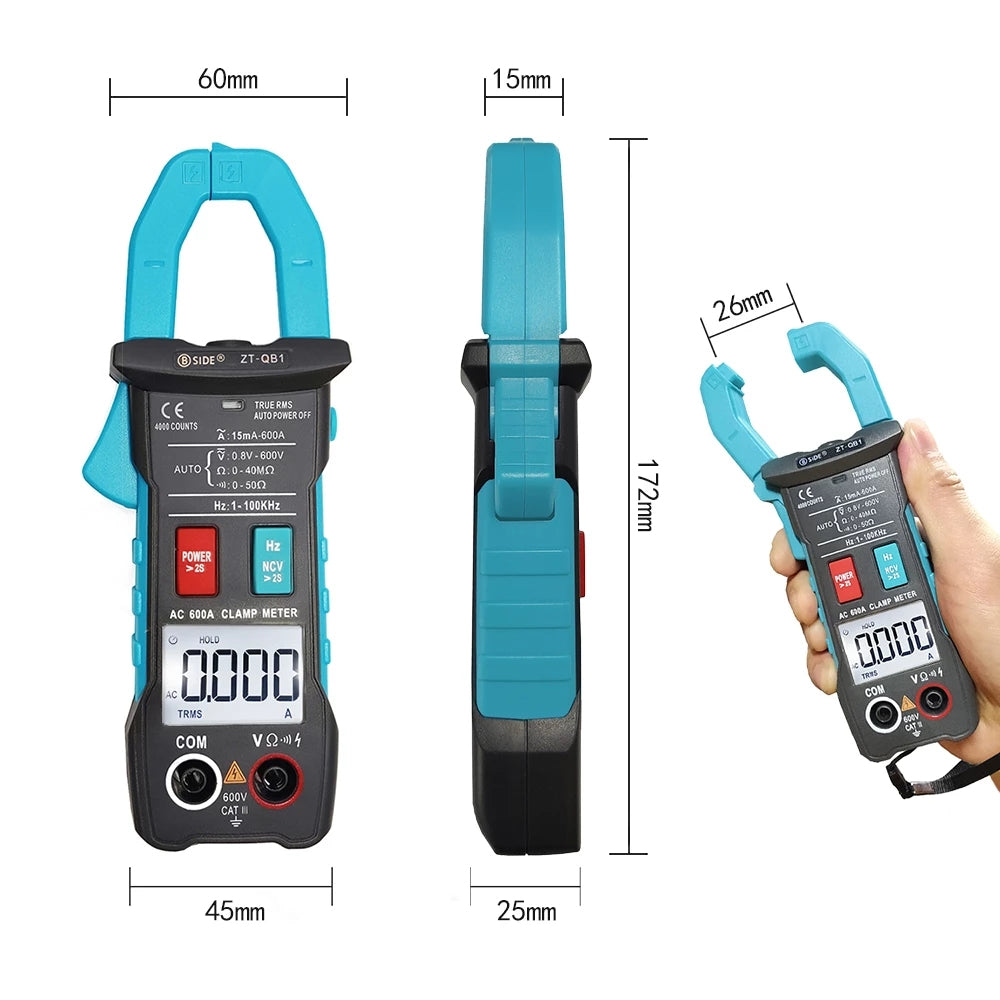
A practical diagnostic tool for tracking down net current, grounding current, and hidden sources of elevated magnetic fields.
A magnetic-field meter can tell you that a problem exists. A clamp meter can help you figure out where the current causing it is actually flowing.
We use this True RMS clamp meter during EMF investigations to measure current on electrical wiring, grounding paths, metal plumbing, coaxial cable, and other conductive paths where unintended current may be present.
For Building Biologists, EMF professionals, electricians, or anyone learning to investigate electrical environments, this is an extremely useful troubleshooting tool.
What We Use It For
Measure Net Current on Electrical Wiring
Clamp around all current-carrying conductors of a circuit together to measure the current that is not canceling out.
In a properly functioning circuit, current traveling out on the hot conductor should return on the intended neutral conductor. Because those currents flow in opposite directions, their magnetic fields largely cancel.
If some current returns by another path—such as grounding conductors, plumbing, structural metal, cable shielding, or another neutral connection—the clamp meter can detect the remaining net current.
That net current can be an important clue when investigating elevated magnetic fields.
Track Down Ground Loops and Unintended Current Paths
Clamp the meter around conductive paths such as:
-
Electrical cables or groups of circuit conductors
-
Grounding conductors
-
Metal water pipes
-
Other bonded metal piping
-
Coaxial cables
-
Cable-TV grounding conductors
-
Other conductive paths suspected of carrying current
Finding measurable AC current where you do not expect it can help narrow down the source of a wiring problem, neutral-to-ground connection, shared current path, or ground loop.
This is especially useful when a gaussmeter shows an elevated magnetic field but the source is not immediately obvious.
A Great Companion to a Magnetic Field Meter
These two instruments answer different questions:
Magnetic-field meter:
“How much magnetic field is present here?”
Clamp meter:
“Where is current flowing that could be producing that field?”
For serious troubleshooting, you often need both.
Designed for Investigation, Not Just Electrical Work
This is a general-purpose True RMS electrical clamp meter, but we selected it specifically because its clamp-on current measurement makes it useful for EMF and building-electrical investigations.
It can also perform standard electrical measurements including:
-
AC current
-
AC and DC voltage
-
Resistance
-
Continuity
-
Frequency
-
Inrush current
-
Peak hold
-
Non-contact voltage detection
The 25 mm clamp opening makes it easy to test individual conductors, cables, coax, grounding conductors, and many common pipes without disconnecting anything.
How Clamp Measurement Works
The clamp measures AC current without electrically connecting to or interrupting the conductor.
Simply close the clamp completely around the conductor or group of conductors you want to investigate.
For net-current testing, the placement of the clamp matters. Clamping only one conductor measures the current on that conductor. Clamping the appropriate conductors together allows you to look for current that is failing to cancel and may be returning through another path.
Understanding what conductors are inside the clamp is essential to interpreting the reading correctly.
Who Is This For?
Recommended for:
-
Building Biologists
-
EMF consultants
-
EMF testing professionals
-
Electricians investigating magnetic-field issues
-
Healthy-home professionals
-
Home inspectors
-
Advanced DIY investigators
-
Students learning electrical and EMF troubleshooting
If you are trying to move beyond simply measuring fields and begin understanding why those fields are present, a clamp meter should be part of your toolkit.
Specifications
Display: 4,000 counts
Jaw capacity: 25 mm
True RMS: Yes
Auto-ranging: Yes
AC Current
-
4.000 A: ±(5% + 5 counts)
-
40.00 A / 400.0 A / 600 A: ±(2.5% + 8 counts)
DC Voltage
-
4.000 V / 40.00 V / 400.0 V / 600 V
-
Accuracy: ±(0.5% + 3 counts)
AC Voltage
-
4.000 V / 40.00 V / 400.0 V / 600 V
-
Accuracy: ±(1.0% + 3 counts)
Resistance
-
4.000 kΩ: ±(1.5% + 3 counts)
-
40.00 kΩ / 400.0 kΩ / 4.000 MΩ: ±(1.0% + 3 counts)
-
40.00 MΩ: ±(1.5% + 3 counts)
Frequency
4.000 Hz to 40.00 kHz
Accuracy: ±(0.1% + 2 counts)
Additional Functions
-
Continuity buzzer below approximately 30 Ω
-
Inrush current
-
Peak hold
-
Data hold
-
Non-contact voltage detection
-
Clamp frequency measurement
-
Auto power-off
-
Backlit display
-
Built-in flashlight
-
Low-battery indicator
Power: 2 × AAA batteries, not included
Dimensions: 172 × 64 × 32 mm
Weight: approximately 172 g
Package Includes
-
1 × BSIDE Digital Clamp Meter
-
1 × Set of test leads
-
1 × Carrying case
-
1 × Set of C3104 crocodile clips
-
1 × Nylon lanyard
-
1 × User manual
ElectraHealth Note
Measure before guessing.
Elevated magnetic fields are often blamed on nearby appliances, panels, or wiring simply because they are physically close. But magnetic-field problems can also result from current taking unintended return paths through grounding systems, plumbing, coaxial cable, building metal, or interconnected electrical systems.
A clamp meter gives you another piece of the puzzle: it lets you follow the current.
Find where the current is flowing, understand why it is there, correct the underlying problem when possible, and then verify the result with your magnetic-field meter.


